Thursday, October 7, 2010

habemus papam

There are three books by the newly elected king of literature on the shelf,
Mario Vargas Llosa, whom I'm never sure where to file under: V? L? , like Garcia Marquez, G? M?,
I wonder how long they are going to sit there for. Doris Lessing, last year's elected queen, hasn't moved once I must say, so, either people don't really follow Nobel Prizing stuff, or it is a not so popular title in the literature field as it sounds:"I won the nobel prize last year" " oh that? phiuh good luck with that".
Mrs Lessing 's reaction to the announcement of the prize by the journalist is memorable, she was coming back home from her rounds and they were waiting for her on her doorsteps and found her completely oblivious to the news.I recommend a search on youtube for it, she is pure class. I wonder how did Mr Llosa and Mr Varga respond. We'll see, maybe he shook his own hands.
In the meantime, some other kind of race happened again...do you remember the gold digging adventures of book hunting in the jungle of the donated books set by the Seattle library?
yep, that one. I had to submit myself to the torture of looking for books without having fun again. This time around I managed to have a little fun,though cause I was in good company and left all my expectations outside the door.And this is what I found:

this is a first translated edition, 1934, by M.D. Herter Norton (what is with all these double names!) and when I found it, I made a little shrill that sounded more as if somebody had stepped on my toe rather than happiness. It was happiness, especially cause it reminded me of an exhibition I witnessed in Bologna ,Italy, during my college years, entirely dedicated to Rilke's love correspondence with Lou Andreas Salome, a Russian psychoanalyst of increadible charisma and who broke few hearts and was a very close friend of people like Freud and Nietzsche. The exchange of written words that those two,both of them married to other people, entertained is the most passionate thing I've ever read.

This little green book jumped at me because of its beautiful cover. The Mabinogion-Everyman's library- 11 Welsh stories drawn from the Celtic tradition of Medieval European literature, stories written between 1300 and 1400.


Ivan Goncharov -Oblomov , also a everyman's library edition #878, translated by Natalie Duddington,was another happy discovery that tossed me back in time again, when I went to see the theatrical representation of the book that notoriously starts the first 150 pages with the guy not getting out of his bed, and I remember wishing having a pillow there with me. I will read this classic of Russian literature, one day, without even skipping the first few pages ,because I think our times have a lot in common with the times the writer is describing: the aristocratic inertia of a decadent social class, the aristocracy, surrounded and completely oblivious of it, by the daily struggle of the rest of the world.

Friday, September 3, 2010

naughty summer

I admit it: i neither finished the terrible enfants nor approached cortazar.
instead, I dived into a guilt -free summer read , Little Bee by Chris Cleave, and I picked it up solely for the cover.I fell for it like a fly for a neon light or a wasp for sugary water in a plastic bottle( it really works, I've seen it this summer).
Bright orange background cradling a beautifully drawn profile of a woman,cartoon style, black pencil, twirls and curls everywhere.
The guilt wasn't there because, first of all it was a summer vacation and you are supposed to read caught-by-the-cover books, secondly because the story is about a young girl from Nigeria who is a refugee in England and has to deal with the fact that her status is not recognized nor legalized. The plot is not about her finding true love so that she can stay, nor that she has to solve a crime becoming a cool Nigerian detective in London, although that would make it a good one too. The other reason why I read it, is because once I turned the book to the back to read the synopsis, I only found this explanation: we won't tell you what the book is about, you have to find out for yourself. Intriguing enough for me.
The author is English, he also writes for the Guardian, and he really took his time to research the condition of the immigration centers around London. The subject is very hot over here right now,it seems, and maybe that is why the American editors felt compelled to change its original title, The other hand, into Little Bee ( the name of the main character)?
the other interesting thing is that a male writer chose not one but two female voices as the carriers of the narration, so he put himself not only into the head of a British woman, which could be considered a realistic ambition, but also into the mind of a young Nigerian girl, and as an Italian young woman I can say he did an excellent work.
good book.
after consuming that happy discovery on an airplane crossing over a continent and an ocean, I landed in Italy and felt compelled to go back to my origins and pick up a native of my home town: Baricco. You can find him translated and published here too. I read one of his earlier books entitled City, and what I find amusing is that the characters bear funny and tacky english names and the places described recognizably belong to the American landscape; at one point one of the characters, the unforgettable Miss Shatzy , writes a western that to an unwestern mind like mine seemed incomparably beautiful. This writer too did an excellent work placing his mind into foreign lands.
Crazy idea on a last note: shouldn't big,significant,classic literature be considered human heritage that belongs to the entire population of the world,like water, like health,like natural resources, nullifying therefore the petty efforts of little financial gurus to profit from it? And of course, we the people, would be more than glad to take it upon ourselves to share the costs of production?

Sunday, July 18, 2010

those enfants terribles taking final exams


now that nobody is commenting on these posts anymore, i am positive no one is in the room of this literary salon that is proceeding as slow as a snail in its development.
I can comfortably let a little fart out without feeling deadly ashamed and embarassed and I can talk to myself out loud without seeming crazy.
Therefore, out loud, I will remind myself that right now I'm reading Les enfants terribles by Jean Cocteau, beautiful, one of those reads you know it is going to stick with you, underneath your skin, forever even if,for some obscure reason, you decided that you wanted to forget about it. It is a book I wish I have read ten years ago, at least. Brother and sister share a private world from which the outer world is excluded, a world ruled by the rules of the Game.
Where did I find it? in front of my door-step, delivered by the postman right to my house all the way from Ireland, wrapped in an envelope without the sender's name nor address for a possible return in case it got lost.It could have really gotten lost badly. However I got it and I not only got the book in the envelope. The book was wrapped inside a HAND-WRITTEN letter that started with my name. How often does that happen?
Days go by at the bookstore selling books,buying books,finding and losing books, missing books, forgetting books, pricing books, cleaning books and also discovering books.
So the other day one of those books that speak to you straight from the cover, fell into my hands as randomly as a snow flake on your tongue: Final exam, by Julio Cortazar. By now I have developed the sixth sense of a bookseller which is being able to recognize the smell of a good book and so I approached reading pieces and bits here and there to see what kind of goodness I stumbled on.
Its edition is an advance uncorrected proof of New Directions Books, with an introduction by its translator,Alfred Mac Adam. Towards the end of this very informative intro, the translator tells us that,quote: the book could be considered a summary of the author's readings during the 1940s, from the forgotten detective novels of Nigel Balchin to the almost forgotten existentialist novels of Andre' Malraux. It is tempting, the translator continues, to read the novel as Cortazar's autobiography, but that is inaccurate , even though he infuses many of his literary and esthetic believes into the male characters.For example Andres ,like Cortazar himself, is dazzled by Jean Cocteau's Opium,which opens the door to surrealism.End of quote.
That day my cinese fortune cookie said: today you will believe in magic, books are like invisible bridges over infinite rivers of infinite possibilities. (cheesy as usual!)
Another read I'm going to look forward to.

Thursday, July 1, 2010

las uvas y el viento

I was reminded that I needed to read Neruda ( thank you Joe!) and what I have sitting on my shelf at home is the collection the poet wrote during his exile in Italy, early 1950's, Las uvas y el viento, and since I like games I decided to open the book with my eyes shut and read whatever poem I would blindly choose.
And this is how I came to read, La Policia:
we are
la policia
-and you? Who are you?
where do you come from, where
do you want to go?
your father? your brother in law?
whom did you sleep with in the last seven nights?
-I have slept with my love, I belong perhaps,
perhaps,perhaps,
I belong to Poetry.
And it is so that a gondola
blacker than the others
behind me brought them to Venezia
to Bologna at night,
on the train: i am a wondering shadow
followed by shadows.
I saw in Venezia, the church tower standing
elevating among the pigeons of San Marco
its police-like triple horn.
And Paolina, naked, in the museum,
when I kissed her beautiful cold mouth
asked me: are your legal papers in order?
in Dante's house
under the ancient florentine roofs
interrogations are happening, and David
with his marble eyes,without eye-balls
forgot his father,Buonarroti,
because every day they force him to say
what he saw with his blind eyes.
however that day
when they were taking me to the Swiss border
la policia suddenly encountered,
coming toward them,
the militant poetry.
I won't forget the roman moltitude
that at the station,during the night,
seized me away from the hands
of the persecuting police.

How could I forget Guttuso's fighting gesture
and Giuliano's face
The wave of rage, the hounds' hit on the nose
how to forget Mario,
from whom, exiled, I learned how to love Italy' freedom,
and then outraged the white head
I saw confused
in the rough sea
of my friends and enemies?
I won't forget Elsa Morante's little umbrella
falling on a police's chest
like the heavy petal of blooming strenght.
And so in Italy
by the people's will
with poetry's weight,
solidarity's firmness,
the action of tenderness,
an halt was put to my destiny.
and so it happened
that this book was being born
surrounded by the sea and lemon trees,
listening in silence,
behind the police wall,
how the valorous people
fought and is fighting,
sang and is singing
winning the battle so that I could
rest in the island that was waiting for me
with a blooming jasmine branch in its mouth
and in its small hands the source of my song.

Pablo Neruda


Forgive the rough and poor translation, but I could not find one anywhere on line, so I had to do it myself.
My question is: would we still be capable of defending Poetry with such conviction these days?

Tuesday, June 15, 2010

books and places

I will soon start the featuring of individual books, cause you can only talk about books in general so much before you reach the point of saturation.
However, not just yet.
There is still one reflection I would like to pester you with and it is on the relationship between books and places: the places we find them and the places we read them ( at least the ones that hold a special place in our heart).
So , if you are still sitting on those chairs and reading this, start thinking about your dear friends books and where you bought them, or borrowed them, or stole them, and where you read them.
I found the Idiot by Dostoevsky resting on a shelf in my grand-mother's house, in the country side, i believe during a spring of more than one decade ago, and read it sitting bent in two with the book sitting on my thighs and my forehead almost attached to the pages, I think I developed into a hunchback because of that book , although it was worth it.
I bought The catcher in the rye by Salinger in a Dublin bookstore and read it in a gigantic house without heat nor hot water for showers, but with the most beautiful piano that was sitting in a leaving room nobody was allowed in. I read it that winter, i remember it was cold , it rained a lot, but it was worth it as well.
I found Anna Karenina, Tolstoy, on a shelf at Lamplight Books. It was the first year the store opened. I would drop all the massive amount of work a new business requires and demands, and sat on a stool behind the counter to read it: nothing ,then, seemed more important than reading.
your turn now

Tuesday, May 25, 2010

on banning

this time I don't have a valid excuse to have been silent for so long,except for ,maybe, waiting for having something to say, and that is debatable too.
The chairs and arm-chairs must be empty by now and the fire in the fire-place out.
Oh well, I'll just put on a record, a vinyl of course, on the old gramophone, and continue the rumbling to myself.
Summer is almost here(and by here I am not referring to Seattle) and I've been buying quite a lot of quick reads for it, trying to maintain a certain level of literature and decor (at least in the title and cover). I cannot swear on the content of every single one of them and I'm sure a couple of the nasty ones slipped through the cracks, disguised as critical essays, and gained their position on the white summer stool that I strategically placed next to the entrance and that nobody has shown any interest in, so far.
I have to say that it looks like, for this summer, people have decided to go back to the good old classics. The English classics, the Russian classics, the American classics,the French classics both of the 1800's and the 1900's, you name it,they are on it.
So ,out of curiosity, i went to check my reference book about the 100 banned books, to see which ones of the classics have been banned in history and why, and from a quick and superficial look at the table of contents I realized that just about each and every book ever written has been banned at some point in time and history for whatever reason matched the metality of the time.Even the Bible and the Quran didn't escape the sad destiny or brutal disease of banning...although now that I come to think of it, banning might be just what will keep our funny species reading: tell me I am forbidden to read it and I'll go straight to it.
What I really would like to have a peek at , is the list of books that are being banned right now and we are not aware of their existence because of it, and since at it it would be nice to scroll through the list of the big editors' rejections, the ones that don't even make it past their desks....just a thought.
I'm sure I'm not telling you anything new here, but if you want to follow the apparent trend of saluting the summer by reading or re-reading a banned classic, here there are a couple of suggestions taken from the "100 banned books":
Literature suppressed on political grounds:
Orwell's 1984, of course
Macchiavelli's the prince
Literature suppressed on sexual grounds:
Rousseau's Confessions
Voltaire's Candide
Lawrence's Lady Chatterley's lover
Flaubert's Madame Bovary
Boccaccio's decameron
Nabokov'sLolita
Faulkner's Sanctuary
Literrature suppressed on social grounds:
Twain's Huck Finn
Burgess's a clockwork orange
Whitman's Leaves of grass
Kesey's Cuckoo's nest
Plath's the bell jar
literature suppressed on religious grounds (to which i suggest you get to in the winter)
Mahfouz's children of the alley
Michel de montaigne's essays
Kazantzakis' last temptation of Christ
Giordano Bruno's on the infinite universe and worlds
Darwin's on the origin of species
Rushdie's the satanic verses
happy readings....

Saturday, May 1, 2010

gold-diggers and gamblers


i was lost into books for a while there, and i managed to free myself from them only because i found out that by ignoring them,they disappear....in reality that is how long it took me to recover from the by-annual Seattle public library huge sale where all books are one dollar ,unless you go into the fenced "better books" area, which should be really re-labeled the " same books like outside,just more expensive" area. All in all it was like going into a hell designed just for book-dealers, where not only you pay money to enter hell, but you voluntarily decide to enter and suffer the pain that the flames inflict upon you. The place's hot temperature is due to the fact that the room is a sort of green-house with big windows, and on top of that you have to fight your way through a herd of people with red eyes and smoke coming out of their noses ready to horn you if you happen to be in their way. The majority of the crowd is divided into two categories: the gold-diggers who come with these little computerized machines,the scanners, which scan the books' barecode and immediately tell you whether the book is worth to sell on amazon.Usually this category consists of people who know nothing about books and possibly never read one,howevver I still haven't figured out whether they work for somebody who remains in the shadow or they do it out of their basement as second job
(this is called book-spy talk).
The second category is represented by people like me who has acquired some knowledge but is still guessing a lot, and so I buy hoping to have paid less that what the book is worth but it doesn't always happen that I'm lucky that way. The rest of the crowd consists of regular readers who come to stock on cheap but good books and students.
Since I'm not interested in gambling for fun and for work necessity I'm not good at it, I decided to let it go and just look for stuff that looked interesting or different or unusual and ultimately just fun to be surrounded by at the bookstore. And magically, as soon as I did that, one after the other the good books came to me, jumped into my lap like frogs and hit my eyes like a flash-light.
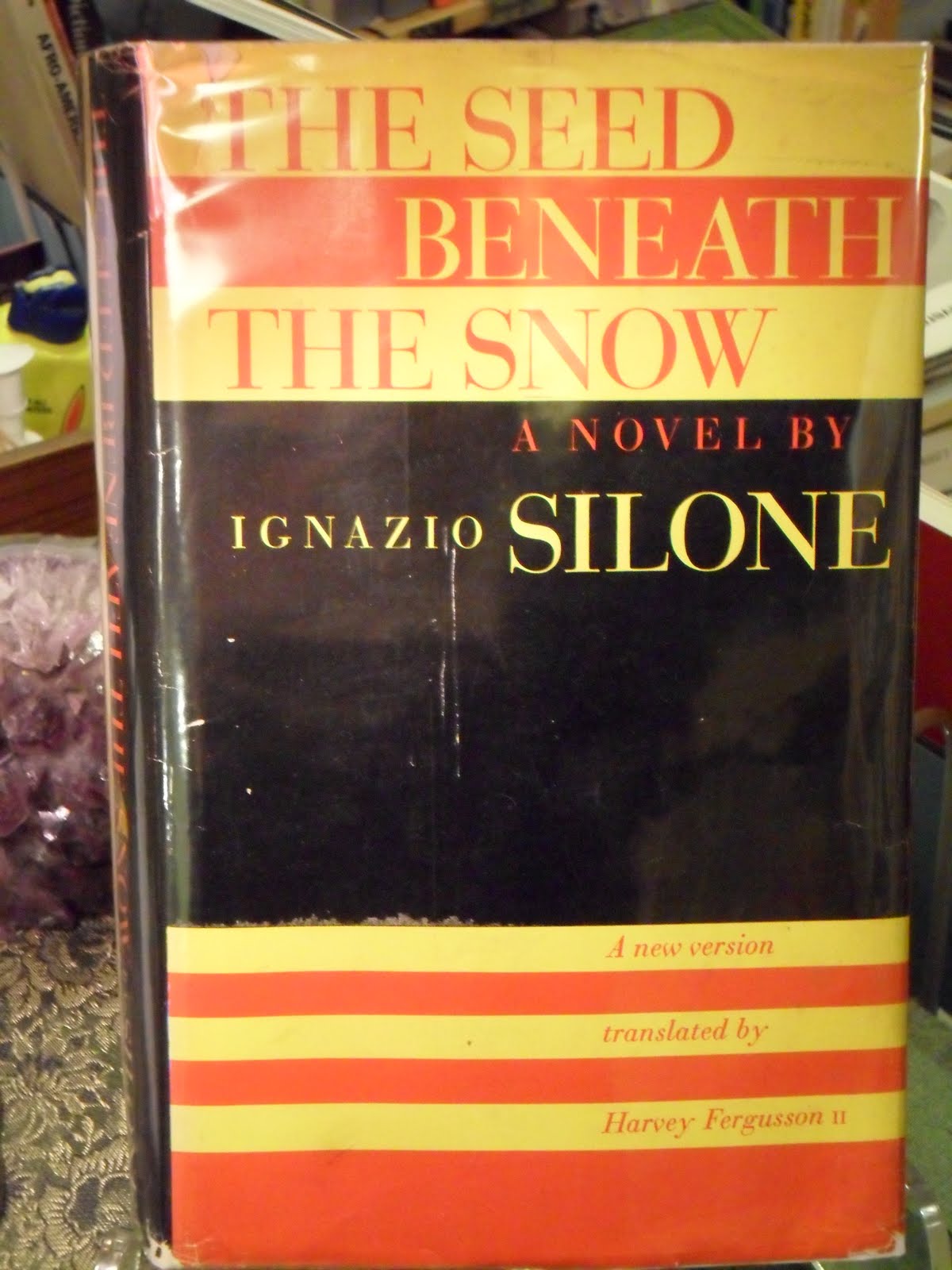
Among them ,I happened to come across a series of italian modern classics, the ones that never get to be read in highschool because by the end of the school year it is too late to pack them in after months and months of renaissance poetry and 1800's literature.The modern writers ,the ones that lived through the wars and observed the post-war re-defining era become a sort of underground culture you discover by yourself during the summer months when you can read the books you want. So during those months of hot sunny days ,yellow with light, red with tomatos on the vines, blue with the sea and green with basil ,you read about the realist writers who display inner conflicts and daily struggles with real poverty , you read about the disillusioned idealist who have to face political contradictions and failed philosophies, you read stories of places destroyed by years of despotism and two global wars that left a collective consciousness filled with disenchantment and confusion about how it could have all possibly been real. And so,like the movies made during those years, the books too unravel out of a surrealistic atmosphere as though it is all a strange dream....
here the pics
if you haven't noticed, i will mention the fact that among these finds there is a heavy absence, that one of women writers who belong to the same group as these fellows up here. I couldn't see anyone of them down there in hell and maybe that is because there aren't many women who end up in hell being immediately sanctified by the origin of their nature. One I have to mention just in case you one day happen to come across a translation and wonder whether you should read it: Elsa Morante. Anything that she wrote is a rare treasure to look at.